For the last few months, I’ve been using [IObit SmartDefrag][sd]. It
is a freeware defrag program that keeps your drive running
fast. Basically, you install it and it runs in the background, like a
librarian silently alphabetising your book collection. Your machine
can find and load files faster. Anyway, it feels like my machine has
stayed fast, where I would have expected it to slow down over
time. Anyway, it’s freeware, it seems to be reliable, and it’s kept my
machine fast. Can’t go wrong.
Month: February 2008
-
-
So, just in case you didn’t know about Mr Fry’s [blog][] and new [podcast][] — you’ve been told.
[blog]: http://stephenfry.com/blog
[podcast]: http://www.stephenfry.com/podcasts/ -
A friend of mine, Rob Ahrens, asked me how my learning of the
programming language Lisp was going. I thought I’d respond in an open
letter.Um, Hi, Rob.
I have two previous posts on lisp, [A programming language only a mother could love][blog1], and [lisp, the beautiful hydra][blog2].
[blog1]: http:2007/04/02/a-programming-language-only-a-mother-could-love/
[blog2]: http:2008/01/21/lisp-the-beautiful-hydra/Childhood Nightmares
——————–When I’ve had time, I’ve been attempting the problems in [Project
Euler][pe]. Euler lays out a series of ~200 mathsy programming
puzzles, things like ‘find the sum of all the even-valued terms in the
Fibonacci sequence which do not exceed one million.’ I’m using them as
a way of trying out the language. At my side, possibly the only decent
beginner’s book, [Practical Common Lisp][pcl]. (It’s also free.)So far, I’ve finished 2 problems. Hmm. I’m pretty sure I could have
finished more of them, more quickly, in almost any other language.That, I think, is at least in part that lisp doesn’t come naturally if
you’re used to non-lisp languages, things that bear a resemblance to C
or BASIC. I’m having to go right back to basics, learning to construct
things in a new way. Here’s the code I used to solve problem 2;(defun fibseq (max)
(let ((result ())
(n-1 1)
(n-2 0)
(term 0)
(i 0))
(loop
(setf term (cond ((= i 0) 1)
((= i 1) 1)
(T (+ n-1 n-2))))
(setf n-2 n-1)
(setf n-1 term)
(setf i (1+ i))
(when (> term max) (return))
(push term result))
(print result)
result))(defparameter allfib (fibseq 1000000))
(defparameter evenfib (remove-if-not #’evenp allfib)); the answer!
(print (reduce #’+ evenfib))I don’t print this here to demonstrate the clarity of lisp. In fact,
the opposite. This looks like hell to me, at least right now. There
is, no doubt, a *far* better way to do this. But I don’t know, and so
I’m writing programs that are terribly inelegant. Nestled in the code
above is a non-terminating loop with a break condition, because I
couldn’t figure out how to do the equivalent ofwhile (n < 1000000)
{Right now I feel like I did when I was ten, programming in BBC basic
and using GOTOs. Hell, it knocks together working programs, right? But
you don't want to stay there too long. That feeling of childhood
programming, though… there's something compelling in it. Lisp tastes
of nostalgia. Remember programming Logo? Or BASIC? Lisp is making me
feel like that. At least for now.Pretty soon, I hope to have mastered basic loops. Then I'll be well on
my way.(setq *subject* (list '( ')))
—————————–Or, now I will talk about parentheses.
In my head, despite being entirely uncomfortable with `while` loops,
I'm starting to see everything falling into a lisp syntax. The idea of
just bracketing up your stuff into lists seems like a great
first-draft syntax for *everything* — want to talk about data
structures? write(data
(entity1 (attribute1 attribute2))
(entity2 (attribute3 attriubte4)))want to write pseudocode for a function call?
(func (param1 param2) …)
want to write a todo list?
(do
(buy bread)
(tidy (kitchen living-room bathroom))
(get life))Valentines day coming up?
(get-count
(make-list #'(lambda (i thee)
(permute #'love i thee))))Ok. Maybe not. (apologies to Elizabeth Browning there.)
But you get my point. I hope. Those brackets are just fine for
*everything*. I'm starting to understand why hardcore lispers want to
do everything in lisp. My brain is infected with brackets.But for right now? I'm going to learn to do a `for` loop, and then
we'll see.[pe]: http://projecteuler.net/
[pcl]: http://www.gigamonkeys.com/book/ -
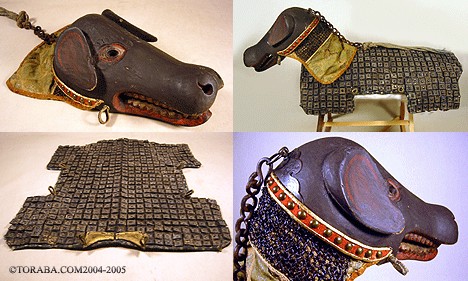
Fun oddness; [Samurai Dog Armour](http://feeds.feedburner.com/~r/PinkTentacle/~3/233241950/)
>This suit of dog armor — identified by antique Japanese armor dealer Toraba.Com as the only known and certified authentic example of its kind — is believed to have been created for the pet of a wealthy, high-ranking and presumably eccentric samurai or daimyo (feudal lord) in the mid to late Edo period (mid-18th to mid-19th century)
[link](http://feeds.feedburner.com/~r/PinkTentacle/~3/233241950/)
-
_Over Christmas, I spent six and a half hours driving from York to
Pembrokeshire, to stay with Clare’s parents. What should have been a
hellish drive was significantly more pleasant than expected. I’m going
to talk about why, and make a wider point about life hacks._Long-distance driving, especially somewhere you’ve never been before,
can often be nasty. You have to juggle several things at once —
planning the route, controlling the car, talking to your passengers,
etc — and you have time pressure, too. For me, this means stress.Two things, I think, made the journey much more pleasant;
1. I drove an automatic,
2. I used GPS to navigate.This offloaded several tasks from my brain; I no longer had to plan a
route; everything was handed to me in simple-to-follow
left/right/straight on choices, and if I made a mistake (which I did a
couple of times) the GPS just routed round it, giving me a new route
which got me there.The automatic gearbox also made things easier. That part of my brain
that would normally be making sure I was in the right gear was no
longer occupied.Life was simpler, so life was sweeter.
Joel, of the [‘Joel on Software’][jos] site, uses the analogy of
automatic transmissions when he talks about some [benefits for
programmers][bfp] (scroll to ‘Automatic Transmission Wins
the Day’). The wider point really is that freeing up your mind from
one type of detail is like juggling with one fewer ball; it’s much,
much easier.[jos]: http://www.joelonsoftware.com/
[bfp]: http://www.joelonsoftware.com/articles/APIWar.htmlSo this is my wider point; anything fully automatic (I mean really and
truly don’t-make-me-think automatic) makes your life less stressful.The flipside, of course, is control. You always sacrifice a little
control to the system. You lose precise throttle control in an
automatic car. You lose control of exactly what stocks you own if you
buy an index-tracker ISA.I think this scares people, but really shouldn’t — this level of
detail will probably tire you, stress you, and give very little
benefit over the automatic method.I’ll finish with a fantastic quote from [Alfred North Whitehead][anw],
co- author of the [Principia Mathematica][pm];[anw]: http://en.wikipedia.org/wiki/Alfred_North_Whitehead
[pm]: http://en.wikipedia.org/wiki/Principia_Mathematica> It is a profoundly erroneous truism, repeated by all copy books and
> by eminent people when they are making speeches, that we should
> cultivate the habit of thinking of what we are doing. The precise
> opposite is the case. Civilization advances by extending the number of
> important operations which we can perform without thinking about them.
> Operations of thought are like calvary charges in a battle–they are
> strictly limited in number, they require fresh horses, and must only
> be made at decisive moments. -
I’ve just discovered [‘It’s all text!’][iat], a firefox add-on
that makes it easier to edit text on the web.It’s a pretty simple idea; any textareas (those boxes used for
composing email, writing forum posts, editing wikis, etc) get a little
button;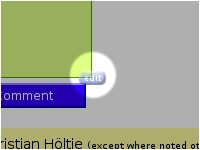
click the button and it’ll let you edit the same text in a
[proper text editor][st]. When you save the file or close the editor,
it copies all the text back into the web page.[st]: http://www.sublimetext.com
[iat]: https://addons.mozilla.org/en-US/firefox/addon/4125All of this means it’s a lot easier to edit text on the web;
especially useful for emails and, well, blog posts. 😉
 Steve Cooper's Personal Blog